
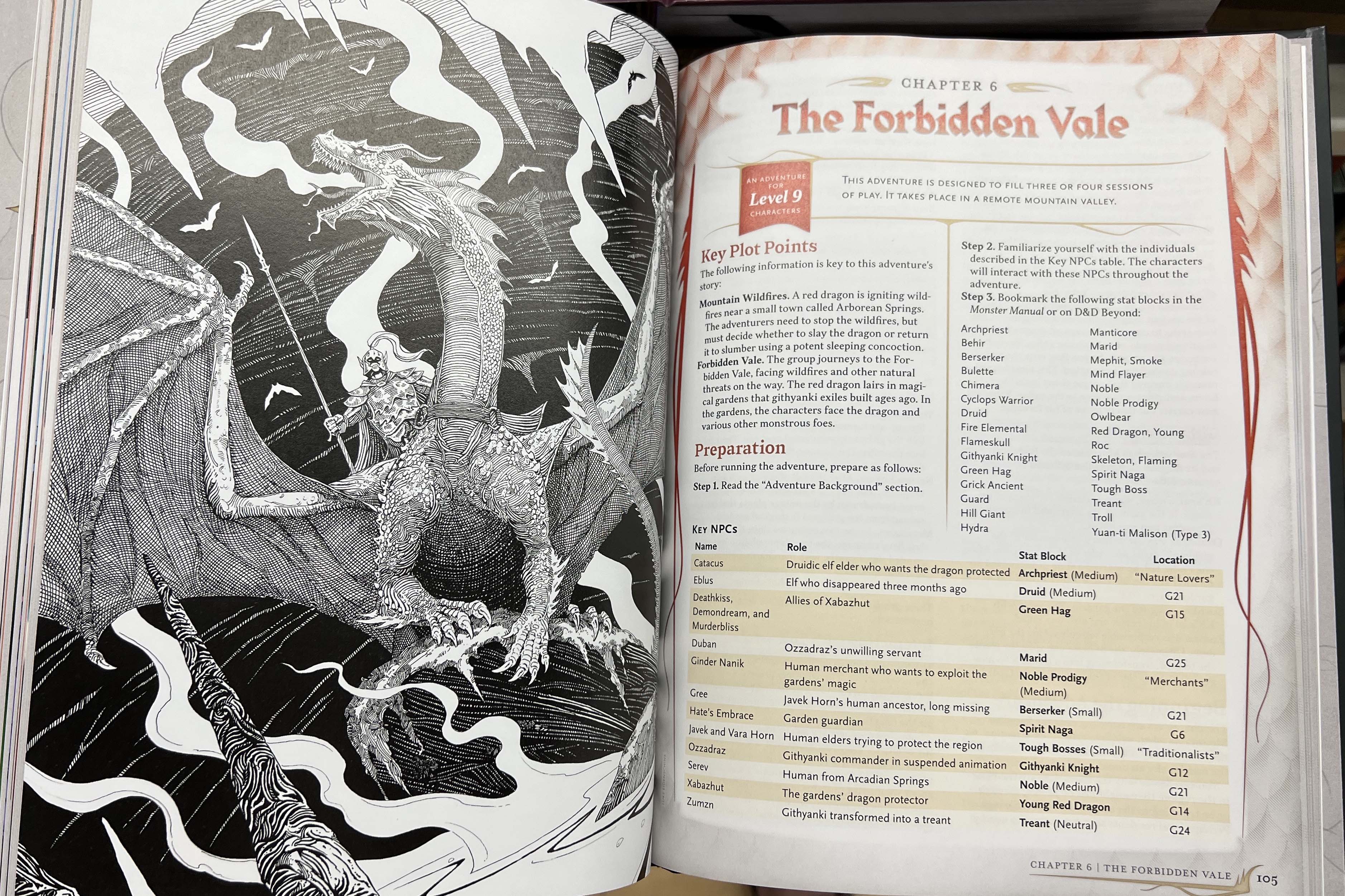
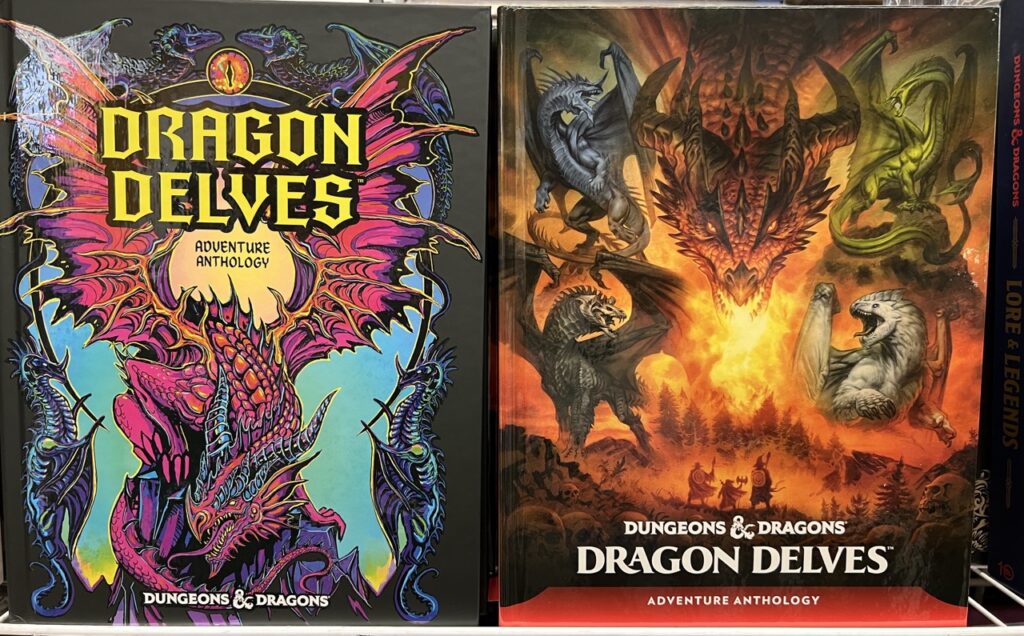
This week on The All Worlds Traveller, we self-interview game designer Steve Townshend regarding “The Forbidden Vale,” an adventure he wrote for the latest Dungeons & Dragons volume, Dragon Delves, which released in game stores June 24 and releases everywhere else on July 8.
(This interview contains spoilers for the Dungeons & Dragons Dragon Delves adventure “The Forbidden Vale.”)
Distant Era: Welcome to The All Worlds Traveller, Steve.
Steve Townshend: Thanks for having me. Without direct questions, I tend to go on.
DE: Yes, I’ve read your blog. Let’s start off with a summary of this book. What’s it about, and what was your part in it?
ST: Dragon Delves is the first Dungeons & Dragons volume published after the 2024/2025 rules refresh, for which I wrote an adventure called “The Forbidden Vale.” Dragon Delves is an adventure anthology featuring dragons in dungeons—two key elements of the D&D brand that aren’t found together as often as one might think.
DE: And why is that, in your opinion?
ST: Perhaps it’s easy to overdo unless you challenge yourself to do something different, which was the assignment the designers took on for Dragon Delves.
DE: How so?
ST: Each adventure in this book features a different kind of dragon found within D&D—both the chromatic (typically evil-aligned) dragons and the metallic (typically good-aligned) dragons. Equally important, each adventure features a different kind of dungeon. For this project, it was important that each designer develop a distinct environment and a distinct dragon.

The Style
DE: “Distinct” is a word many use to describe Dragon Delves, each adventure featuring a different artist, cartographer, and writer-designer, with varying styles. Did you have a particular style in mind when you designed “The Forbidden Vale?”
ST: I had a “classical” style in mind.
DE: An old school revival.
ST: Somewhat. I’d say “The Forbidden Vale” is a modern adventure with old school sensibilities.
During the pandemic, I took a side job running online D&D for twice-exceptional children. In that format, I discovered that the classic location-based adventure modules I’d grown up on worked best. We played I1: Dwellers of the Forbidden City, B2: The Keep on the Borderlands, B4: The Lost City, B7: Rahasia, UK1: Beyond the Crystal Cave, UK4: When a Star Falls, X1: The Isle of Dread, and X2: Castle Amber. I also ran 2e’s Tales from the Infinite Staircase among others. Running these adventures helped me see their brilliance with fresh eyes, and my admiration for the classics grew. To give credit where it’s due, during playtesting for 5e in 2011, Mike Mearls encouraged me to give the classic adventures another look, and that’s when I started to fall in love with them again.
DE: Was there any particular classic adventure designer or reference that resonated with you the most?
Tom Moldvay
ST: Tom Moldvay’s work stood out in particular, and the more I read The Lost City, The Isle of Dread, and Castle Amber, the more I admired him as a designer. His adventures dumped the characters into the action—which I once viewed as a shortcoming but started to view as a strength—but they did so for the sake of economy. Moldvay’s adventures don’t waste space trying to convince the players to go on the adventure. They’re these fascinating sword-and-sorcery-genre environments with interesting NPCs, locations, plots, and captivating journeys into the unknown. They neither assume nor prescribe a course of action but sketch out characters and set pieces and dramas for the characters to encounter and make into their own adventures, their own plots.
DE: To be fair, D&D produces plenty of adventures where characters have agency.
ST: I admire the efficiency with which Moldvay did this in thirty-two pages. Furthermore, he’s the one who wrote the following in the rules by which I learned to play D&D:
The D&D game has no rules, only rule suggestions. No rule is inviolate, particularly if a new or altered rule will encourage creativity and imagination. The important thing is to enjoy the adventure.
Tom Moldvay, Dungeons & Dragons Basic Set, 1981
DE: Do you think that quote is still true?
ST: Having just released a three-volume rules refresh, I think it would be hard to argue that D&D has no rules in 2025. But I think it was true in Moldvay’s time, and I enjoy many RPGs for which this is true today.
A Moldvay-Inspired Sandbox
DE: Is “The Forbidden Vale” a tribute to Moldvay then?
ST: You could say that. When James Wyatt offered me the opportunity to write an adventure for Dragon Delves, I wanted to make a little sandbox full of people, places, puzzles, and problems to explore, which the players and Dungeon Master could make their own, navigating it in any way they choose. In order to do that, I needed to write it like poetry in places, with efficiency of information, abandoning my tendency to elaborate and include as much for the players and DM to play with as possible.
The Art and Maps
DE: “The Forbidden Vale” is notably the only adventure in Dragon Delves that features exclusively black-and-white line art and oldschool cartography, including an overland hex map, which certainly seems to match the tone of the style of adventure you wrote. How did you work with the art department to ensure that consistency?
ST: I did nothing of the kind. When I turned in my submission, I briefly mentioned that “The Forbidden Vale” was my take on an oldschool adventure, and that was all. I credit James Wyatt for being a good listener and to everyone else at Wizards of the Coast and beyond whose hands this adventure passed to who developed it. I honestly had no idea what this adventure looked like until I went to the game store on the day it was released and saw the art and maps.
DE: And were you surprised?
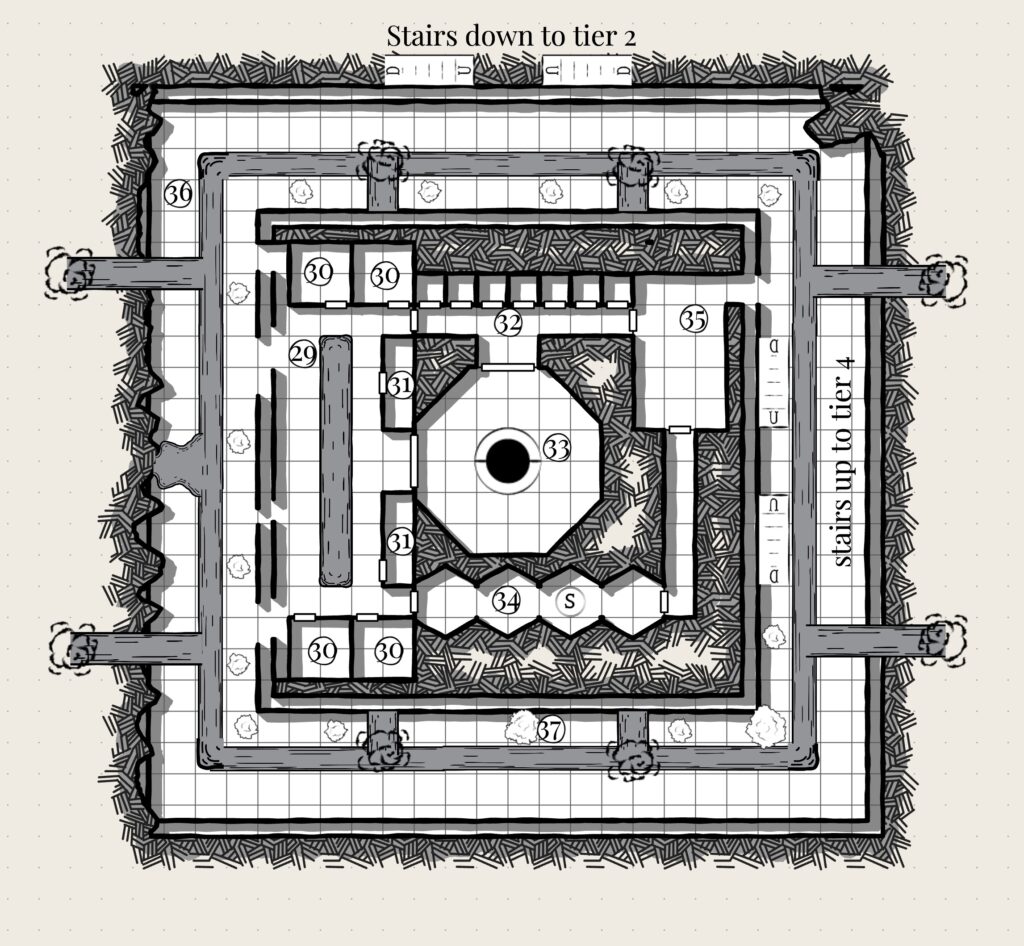
ST: I was shocked. Pleasantly so. I encourage you to take a look at the exceptional line detail in Luke Eidenschink’s work. Check out the videos where he’s drawing line after line after line. It’s incredible. Also check out the beautiful cartography of Dyson Logos, who did the magnificent traditional maps for “The Forbidden Vale.” It feels like everyone who worked on this adventure over the last two years understood what it was about and what style it needed to be without any prompting from me.

The Process
DE: Walk us through the process of adventure design from the beginning. Under what circumstances did you end up working on this book?
ST: I received the assignment unexpectedly while catching up over lunch at Gen Con 2023 with James Wyatt, who I hadn’t seen in nearly a decade. In the midst of conversation, James broached the topic. He started by emphasizing that they they didn’t need freelancers, but he had a need for an adventure writer for an anthology and asked if I’d be interested.
DE: Managing expectations while offering an unexpected opportunity.
ST: Very much, yes, though we’ve worked closely together in the past. In 2009, James gave me my the first freelance assignment of a consistent five-year run writing for D&D (Monster Manual III), and we collaborated on several projects, including adventures like Madness at Gardmore Abbey, War of Everlasting Darkness, and the 2014 5e core books. So it was a pleasant surprise to have the opportunity to work with James again.
The Dragon Pitch
DE: For your Dragon Delves assignment, were you assigned a dragon to work on, or did you propose the idea yourself?
ST: James asked for several pitches for dragons I might be interested to write about. I came up with a dozen ideas for different kinds of dragons, winnowed them down, and sent my favorites.
DE: What’s your approach to writing a pitch? Based on the diverse adventures and styles in this book, the designers seem to have emphasized originality.
ST: I personally don’t strive for that. Usually when I think something’s original, it just means I haven’t been exposed to it before.
DE: So how do you avoid clichés if you’re not aiming for originality?
ST: I think influences, inspirations, and passions form one’s own unique point of view, which is original without attempting to “be original,” so to speak. My pitches were mostly inspired from the history and folklore of different real world cultures, which fascinate me. I submitted at least half a dozen pitches referencing the ancient world.
Ancient World Inspirations
DE: Did any of those influences make it into the adventure?
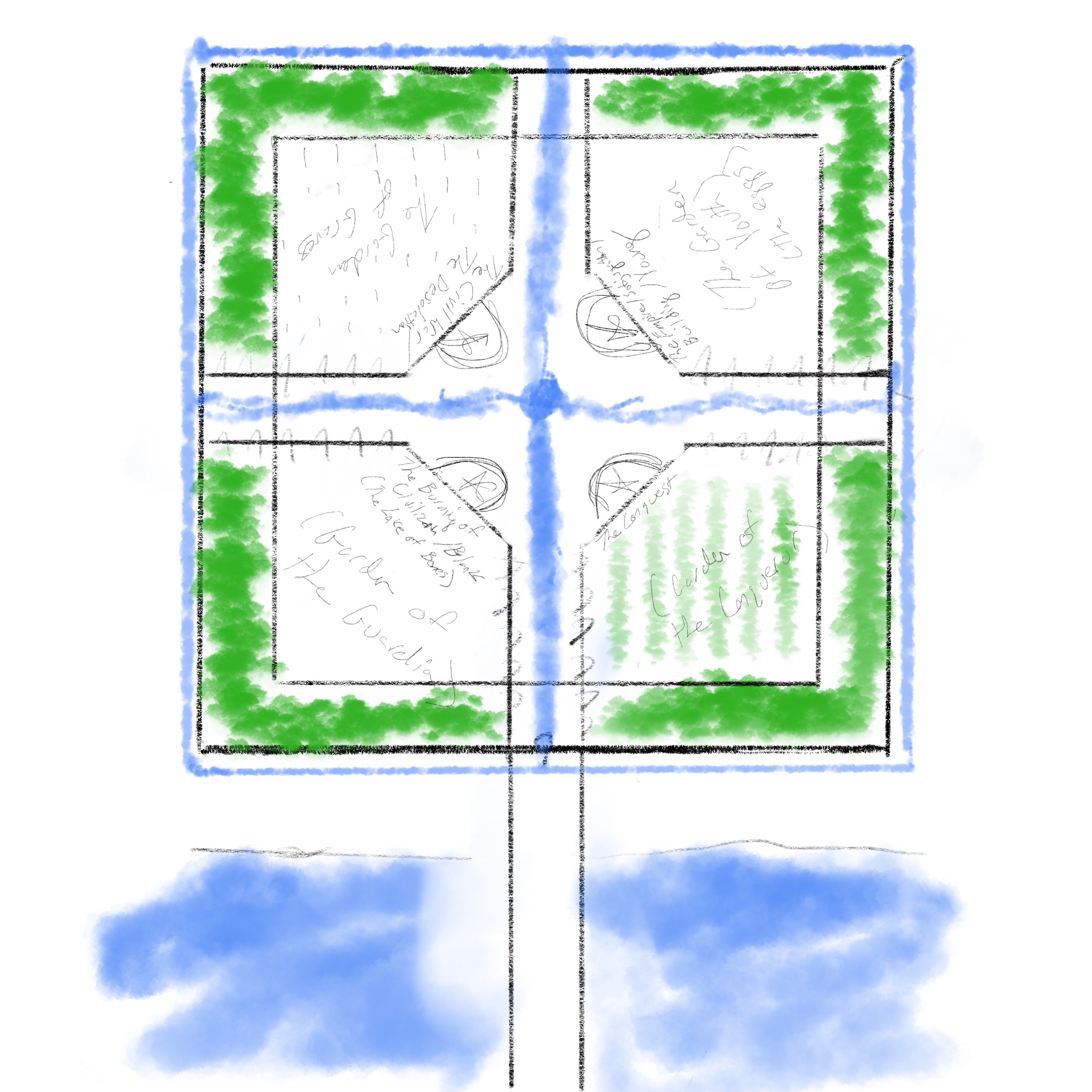
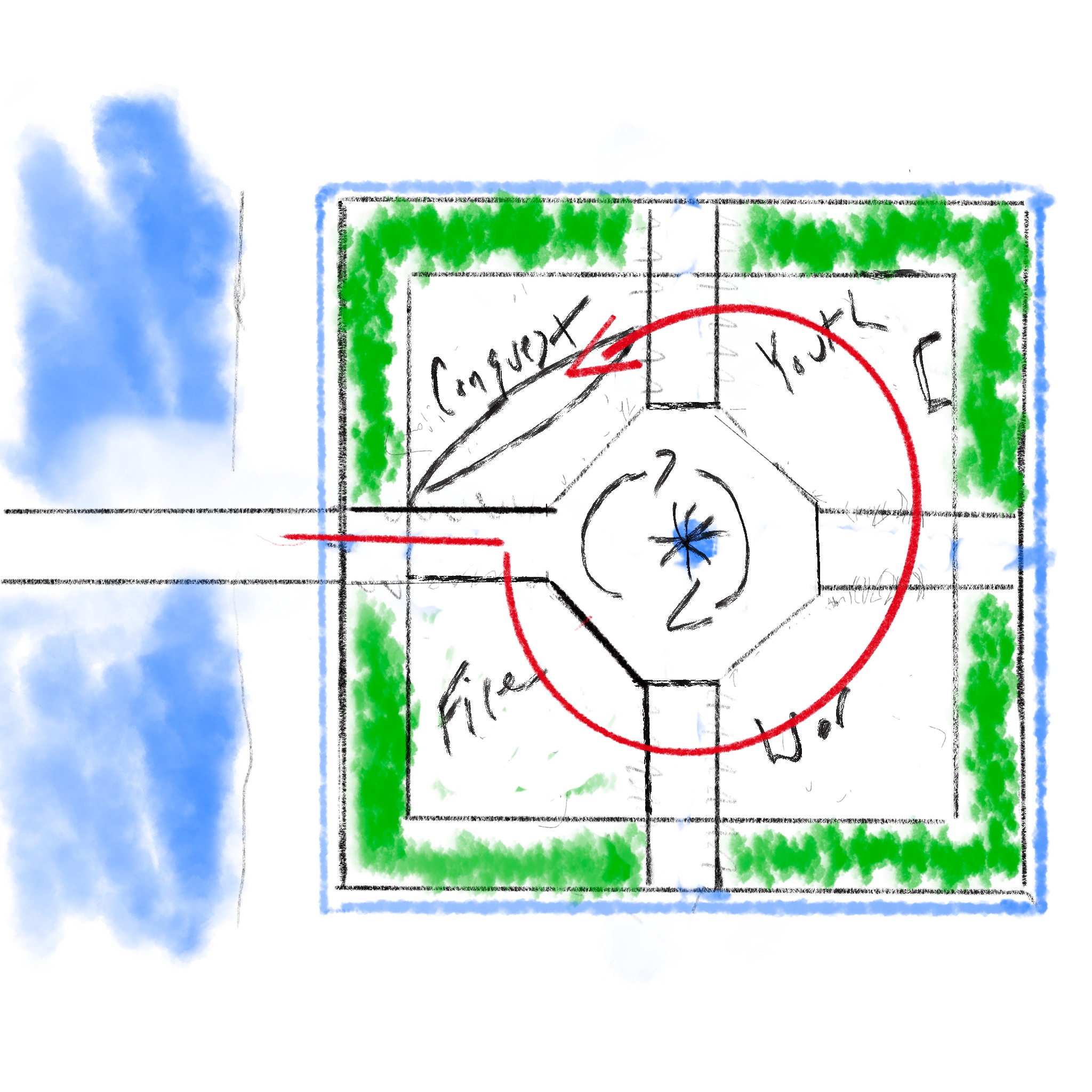
ST: Oh yes. In addition to the ziggurat garden influenced by the possibly fictitious Hanging Gardens of Babylon, I was particularly influenced by reliefs, inscriptions, and history from the Assyrian empire, the Babylonians, and the Egyptians. I’d spent a week or two alluding to a cruel ancient empire that created the gardens when it occurred to me that I should translate this empire into D&D terms somehow. When trying to think of a D&D species that best fit the haughty inscriptions of ancient Assyrian conquerors, the githyanki sprang to mind as the perfect choice. It was only after this that I remembered their close relationship with red dragons. Maybe I went the long way around to make that connection, but we got there in the end.
Dreams and Oldschool Themes
ST: I think the other ingredient to a good pitch is if it comes from where you dream, to borrow from writer Robert Olen Butler.
Among my pitches, there was one image that resonated in particular: a burning forest where inky smoke blotted out the sun, where the skies were red from the perpetual blaze; under cover of obscuring smoke, camouflaged in the forest fire, a red dragon methodically turned the land into a hellscape, but hidden in the middle of the burning land lay an ancient tiered garden whose plants had the power to grant eternal health and youth. It’s the one I secretly wanted to do and it also resonated with James the most.
DE: That’s an evocative image. What made it stand out for you?
ST: It gave me an ominous feeling of apocalyptic dread. It came from the place where we dream rather than the place of ideas. Possibly from the news as well, as wildfires blazed in the West. I wondered what myths, rumors, and history might emerge around this unseen force of destruction, which extended back into the distant past over cycles upon cycles of destruction. It made me think of the mysteries surrounding Ragnarok in the Norse myths and the cyclical nature of the beginning and ending of the world inherent to those stories.
Rumors
DE: Were you tempted to create an oldschool rumors table with true and false information about the dragon?
ST: I did create one! It wasn’t working as a table though, so I decided to present the information in a different way: The adventure features three factions that believe in different approaches and have strong opinions about what’s going on and what needs to be done. Some are more biased than others. Each is right and each is wrong. I divided my rumors table of true and false information among the factions, who all speak the truth from their point of view.
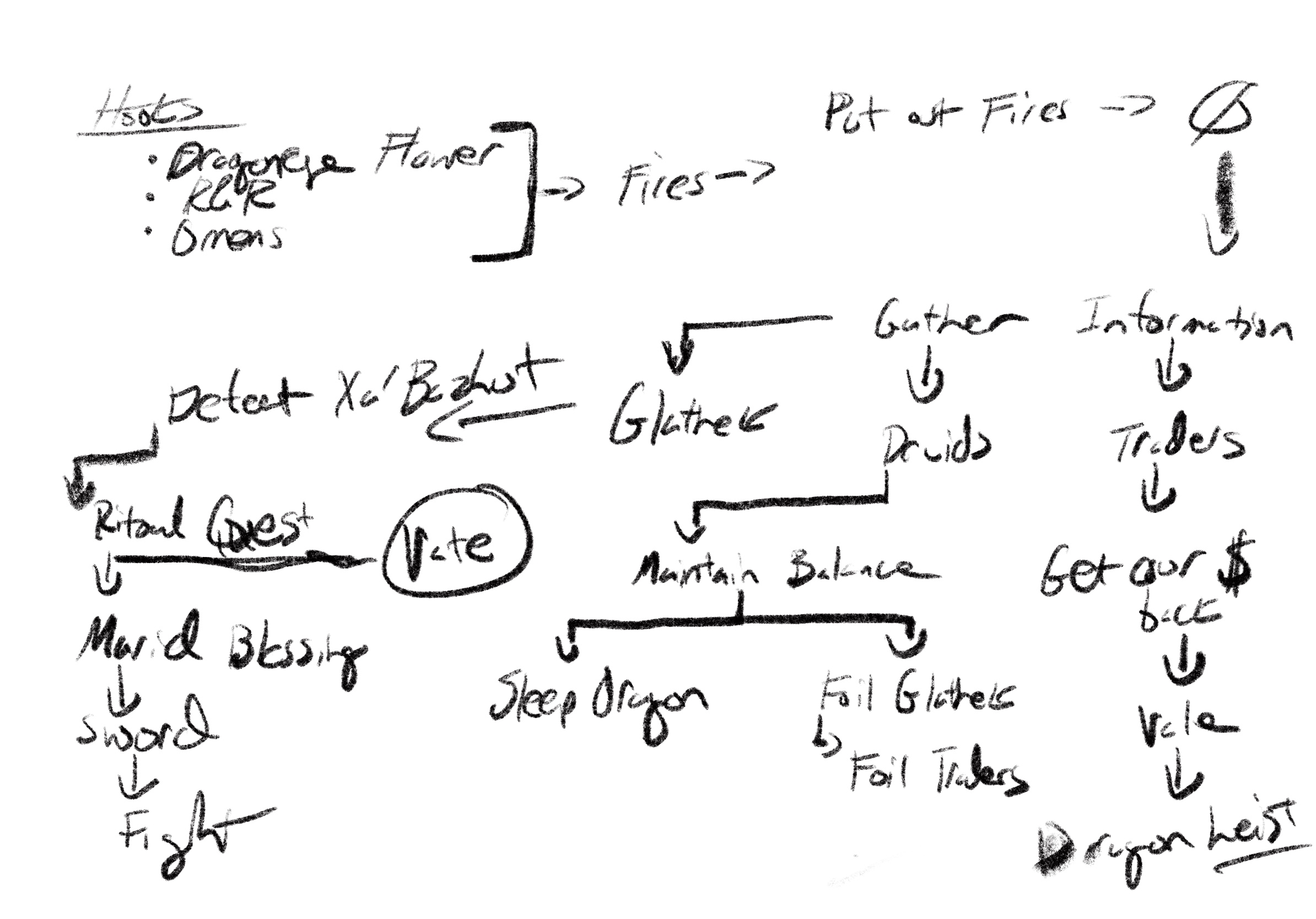
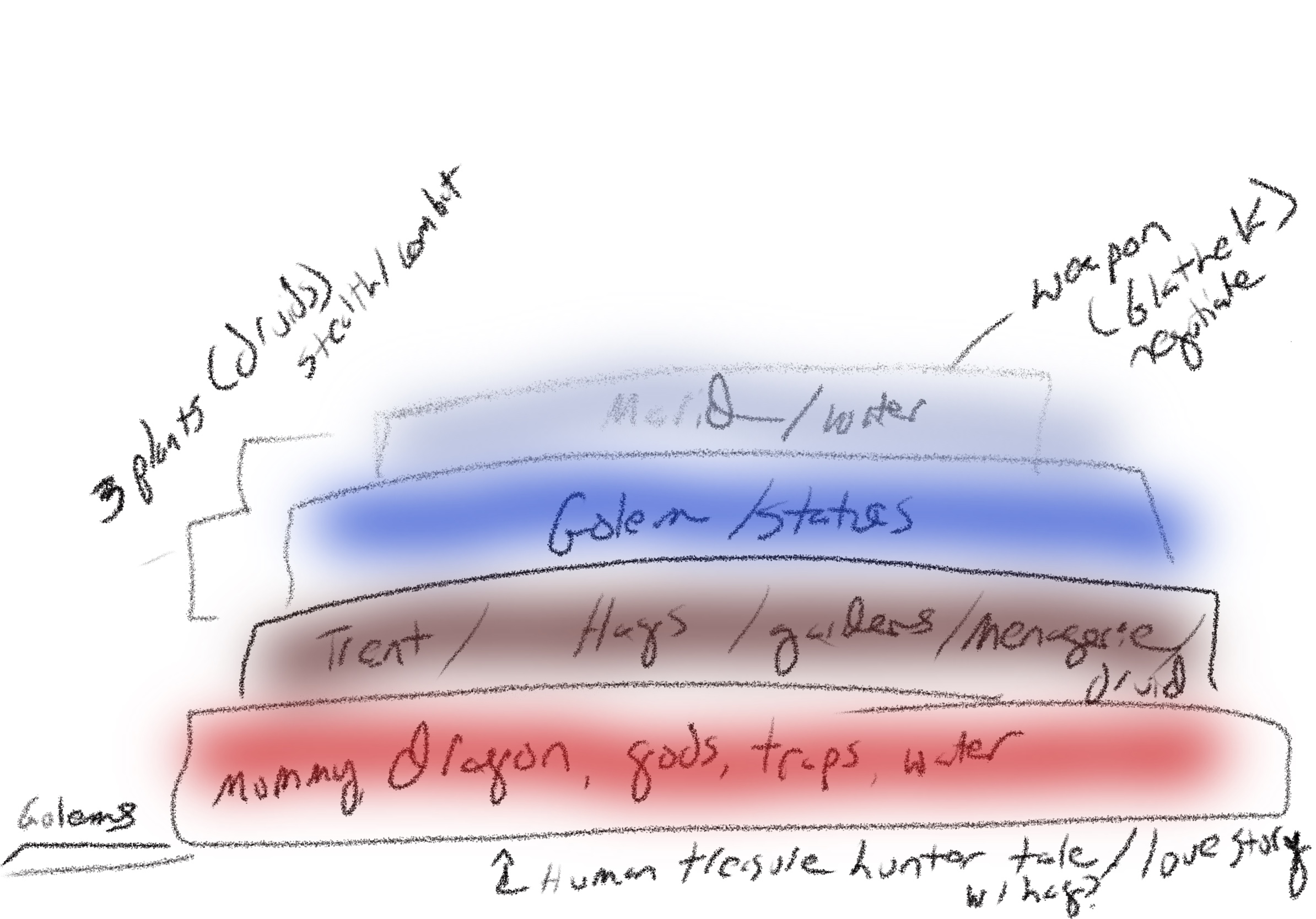
TOP: Handwritten flowchart showing the three hooks for the adventure, along with the three different locations where those three hooks send the characters and the three prospective solutions (fight, sleep, steal).
BOTTOM: Visual catalog of the ziggurats levels, themes, and contents.
Parting Advice
DE: Is there any advice you’d like to pass on to players and Dungeon Masters who play about the adventure?
ST: I don’t think I created a single encounter in “The Forbidden Vale” that has to be fought, which is to say the sky’s the limit for how the characters and DM want to interact with each creature and NPC. The adventure can’t be “broken” because there is no right or wrong choice. Build, elaborate on NPCs, have fun, go nuts, and make it your own.
For groups looking for a deeper story experience, I strongly encourage the DM to read the questions in the conclusion carefully and read them before running the adventure. The adventure will conclude with a choice, and it will cost something. The closing paragraph offers suggestions. Once you understand the group’s course of action, you can start showing what the ramifications of their choice might look like. Making a choice and experiencing its rewards and consequences are part of what makes these games meaningful. For me anyway.
Thanks and Acknowledgements
DE: Dragon Delves is now out at game stores and will appear everywhere else on July 8.
ST: Enormous thanks to James Wyatt for making this come to be and to everyone else at Wizards of the Coast and outside of it who developed, edited, and published “The Forbidden Vale” and Dragon Delves. Thanks also to my students who played a prototype of this adventure while I was writing it (but were too scared to enter the gardens).
DE: Many thanks to designer Steve Townshend for sharing stories with us on The All Worlds Traveller. Last question: Do you talk to yourself often?
ST: Mostly I talk to cats, so this is a rare surprise. Thanks for having me, me.
DE: It was my pleasure.
ST: The pleasure was all mine.
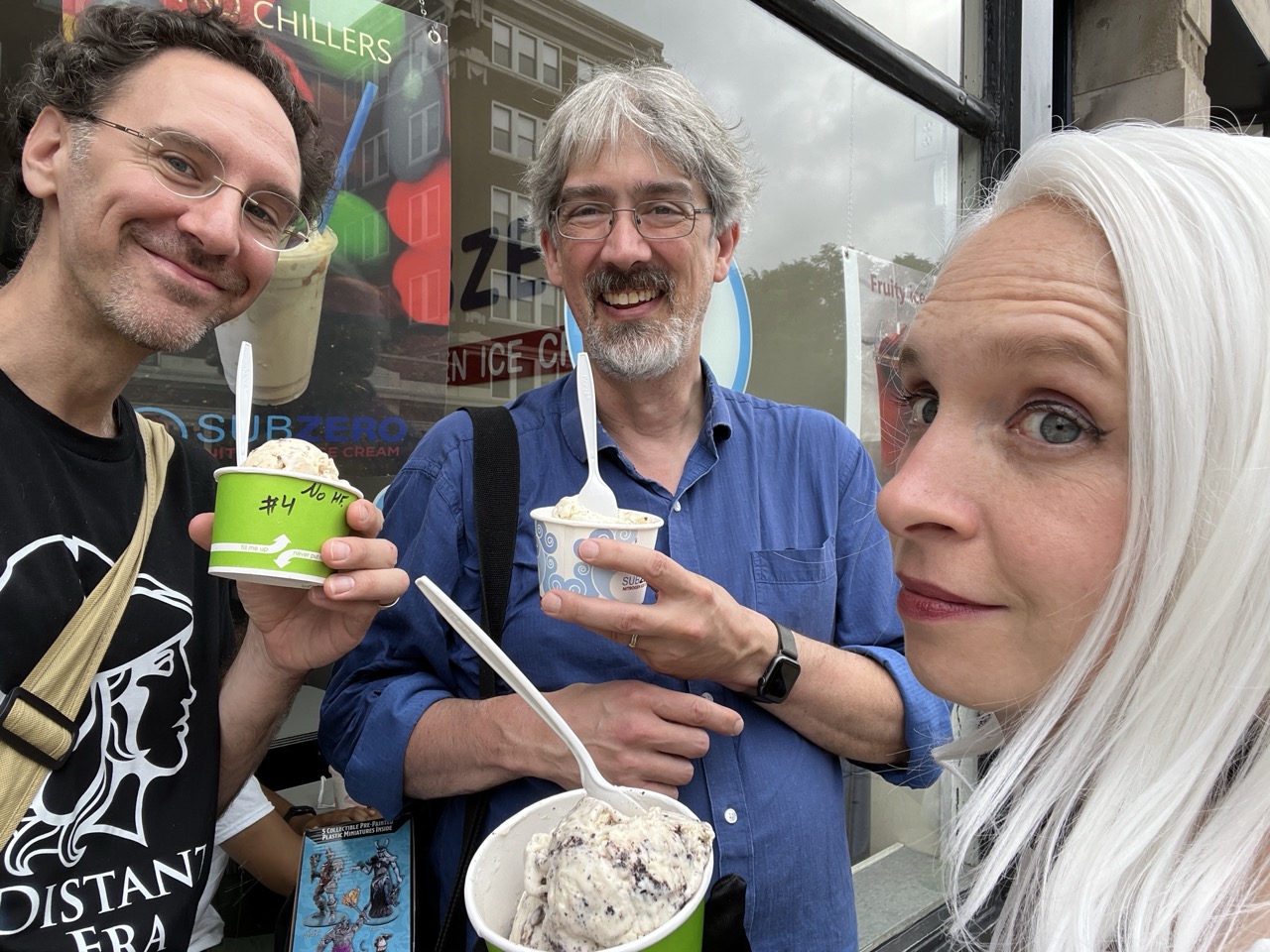
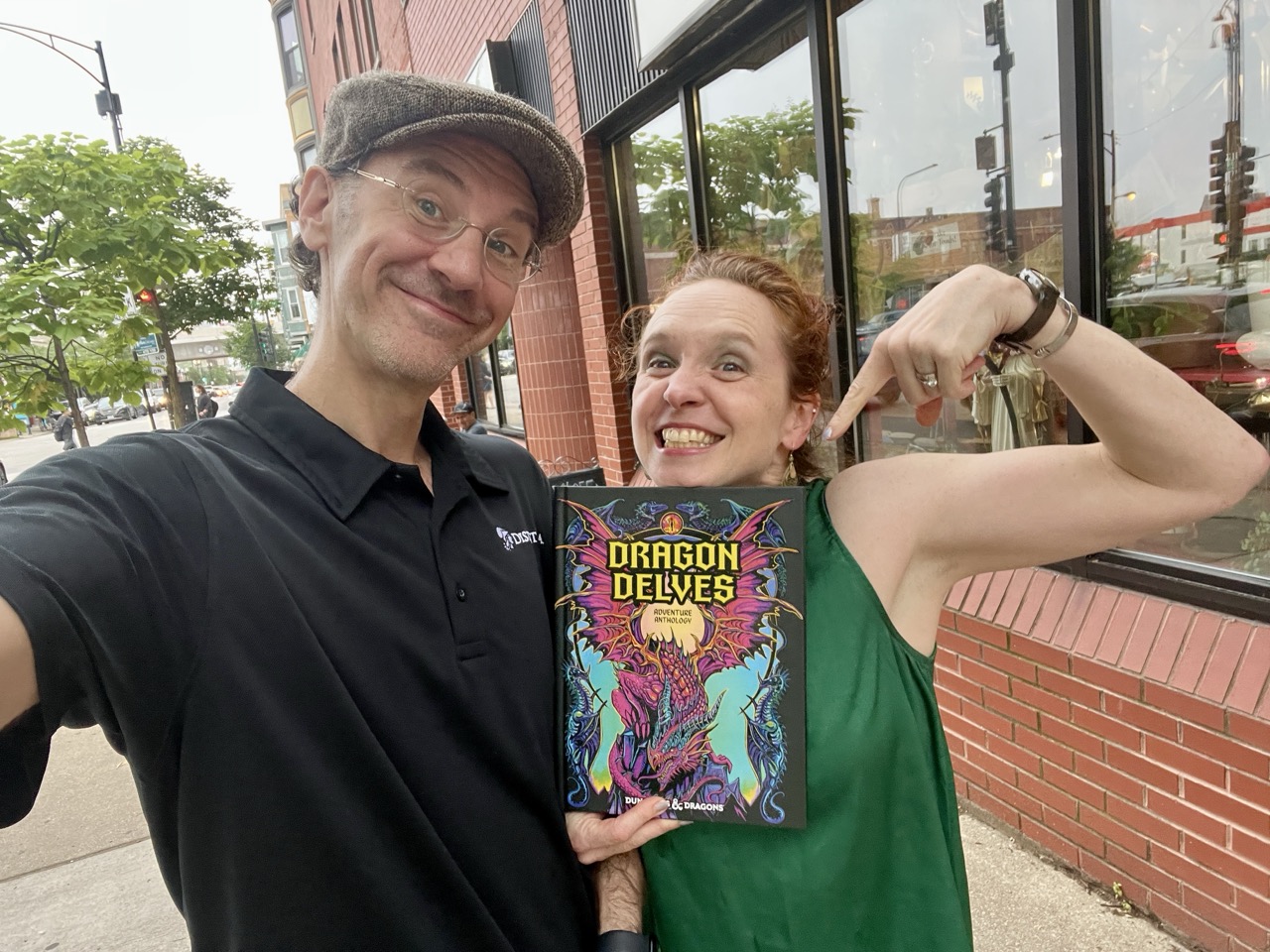
RIGHT: Release of Dragon Delves in June 2025.
(Wardrobe indicates I’m working Distant Era commissions on both days.)










Follow Me