
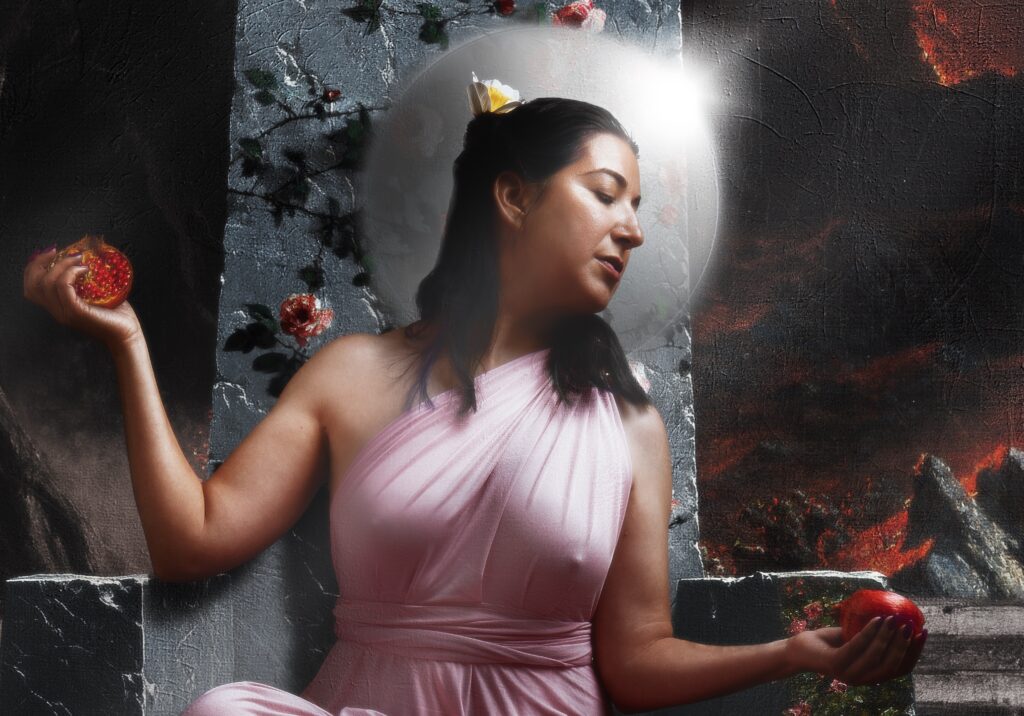
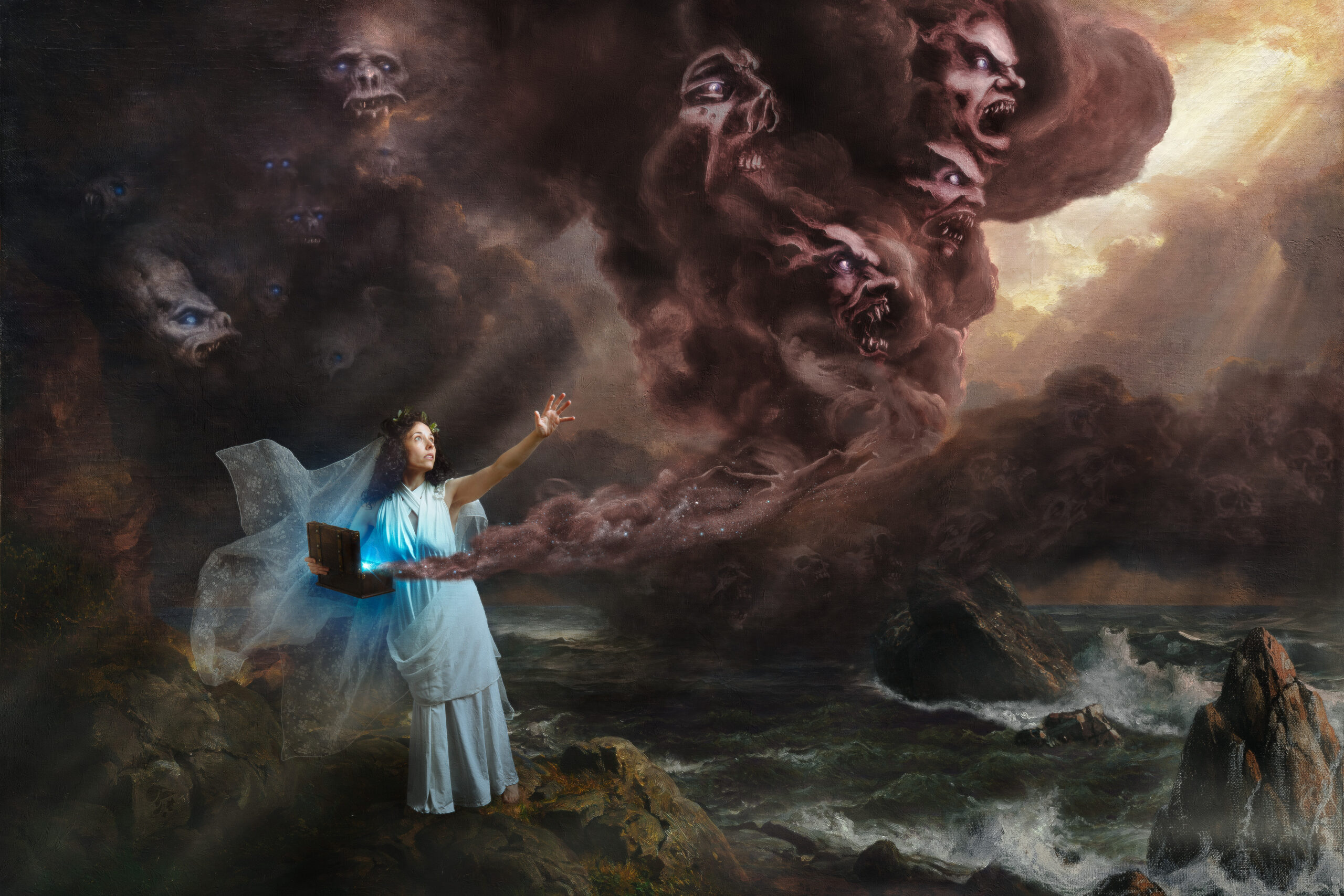
As a birthday present to myself, I am proud to present the second image in Gods and Heroes of the Aegean, a new series about Greek mythology by Distant Era, featuring game designer, actor, producer, writer, and friend Sarah Moore as Persephone.
About Gods and Heroes of the Aegean
- Gods and Heroes of the Aegean is a personal Distant Era series, created by me, for me, with a few of my friends.
- Personal series are my means of trying new things, challenging my skills, and doing the best work I can when time is not a factor.
- This series uses techniques learned from a mentorship with photographer Chris Koeppen of An Aethereal Fire.
- A summary of the God and Heroes of the Aegean series goals and inspirations can be found here.
- Gods and Heroes of the Aegean was photographed in June 2023. Of the fourteen I shot for the series, only two are now complete. The first, Pandora, took roughly a year. Persephone, intended to be simpler, is far more complex and took longer to finish.

Persephone
As for Persephone herself . . . well, it seems that she grew to love her time below as much as her time above. For six months she was no prisoner in Hades but the contented Queen of the Underworld, a loving consort who held imperious sway over the dominion of death with her husband. For the other six months she reverted to the laughing Kore of fertility, flowers, fruit, and frolic.
Fry, Stephen. Mythos: (Ancient Greek Mythology Book for Adults, Modern Telling of Classical Greek Myths Book) (Stephen Fry’s Greek Myths 1).
For Gods and Heroes of the Aegean, Sarah chose Persephone. Adhering to our project goal to portray action, we decided to show Persephone choosing to taste the seeds of the pomegranate that would bind her to the Underworld for the time humankind would come to know as winter.
Before the pandemic, Sarah Moore and I had photographed many sessions with Crescent Moon Nerdlesque, so we were very accustomed to working together, however Gods and Heroes of the Aegean was the first time we worked together on a Distant Era project.
The Shoot
Let’s start at the beginning.
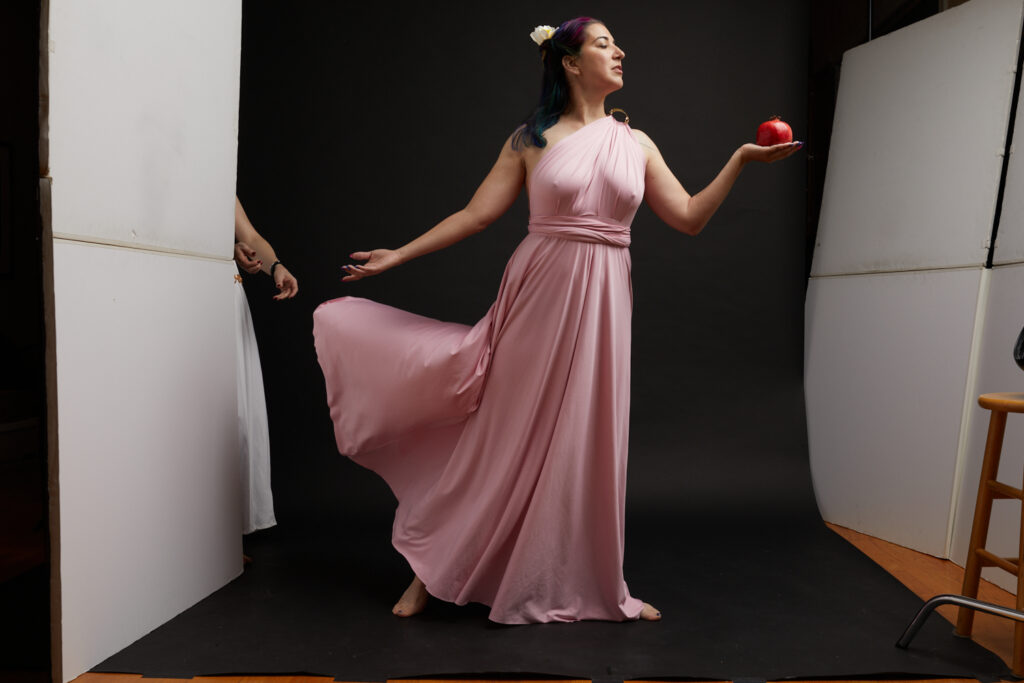
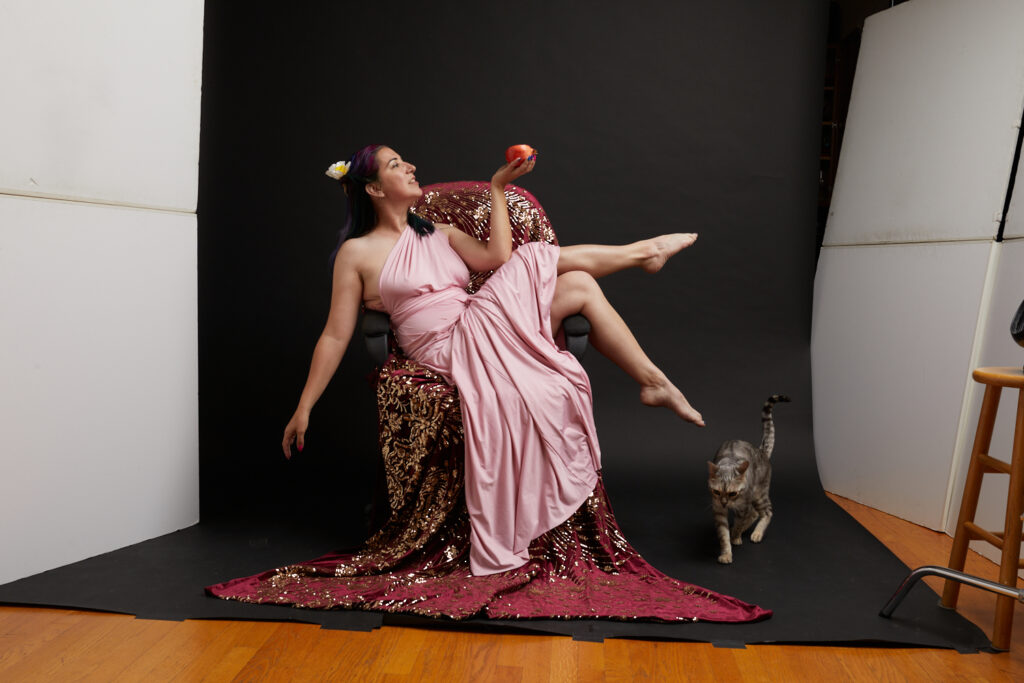
While this series is by far the longest and most painstaking I have ever attempted, it was also among the very quickest to shoot. Most of the dozen subjects came in on a Saturday in June 2023, and we photographed one after the other. For Persephone, Sarah wore a simple floral pink dress that reminded me of hope and spring. She also brought narcissus flowers for her hair, along with her own pomegranate from the grocery store.
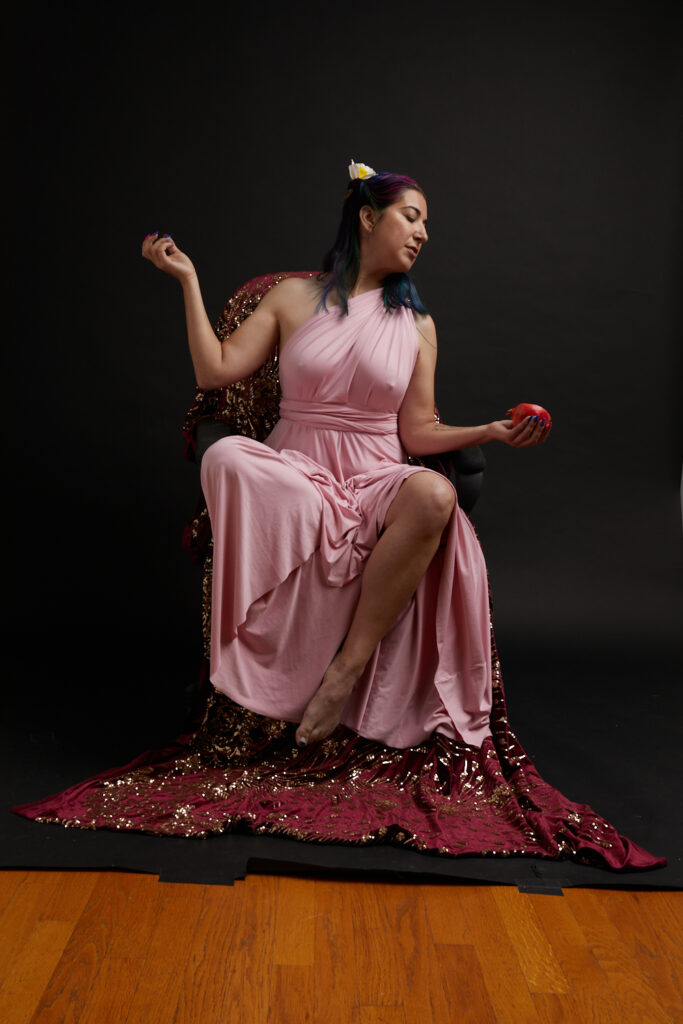
We quickly photographed a number of poses showing Persephone standing, holding the pomegranate. Near the end, Sarah sat in the rolling office chair, which we covered with a fancy fabric. It might be a good option for a seated pose, perhaps on Hades’s throne, I thought.
Settings
The settings for the shoot were extremely basic. We used a large, diffused umbrella as the main light, V-flats to bounce light, and a black background. We photographed the images on a tripod at 35 millimeters, thinking we might composite into a wide frame. Our shutter speed was 1/100, ISO at 100, and our aperture was f/11.
Looking back three years, I think I shot with those settings because with my previous camera, the Canon 5D Mk IV, I couldn’t accurately lock on my subject’s eye at 35 mm while also attempting to photograph the entire subject. At wide apertures, the focus might (and did) easily shift. So I shot at f/11 in order to get as much leeway as I could, with little risk of the subject’s eye moving out of focus.
Since I couldn’t focus on the eye accurately using the viewfinder at 35 mm, I used the camera’s live view feature, which allowed me to tap on the subject’s face, and the camera would find the eyes (something my current camera does automatically). As for the shutter speed, 1/100 is relatively slow and lets in more ambient light, however I knew my flash would freeze motion, so I wasn’t worried about blur. I shot at ISO 100 to ensure the images would have as little visible grain as possible. Today, with different gear, I would shoot this image a little differently.
Visualizing Persephone
A year passed between shooting Gods and Heroes of the Aegean and releasing the first image, Pandora, in June 2024. After so much trial and error creating Pandora, I was looking to do something simple and fast for the followup. I sorted through the images I had and tried various mockups. I made progress on several, but I continued to run into compositing problems I didn’t know how to solve. Many of those had to do with finding the right elements to visualize the scene I was attempting to show. I began work on several different characters, turning around at dead ends as I sought the path of least resistance. Then I thought about Persephone as a potentially easy and fast image to do.
At first, I was drawn to Persephone’s standing poses but worried they might look too presentational. The image of Persephone in the chair, however, gazing at the pomegranate, resonated with me. Sarah’s expression looked contemplative and thoughtful, as though Persephone had a choice regarding her fate, perhaps knowing what the seeds would commit her to, and deciding to make the commitment. A marriage to Hades, both the place and the being. A union with a sacrifice. The bride leaving her mother’s home, but always to return.
I imagined a dark stone throne in a dark realm, a shaft of light piercing the darkness, perhaps settling on the throne and a single shoot of green rising toward the light. Perhaps I’d put three pairs of glowing eyes in the background, representing Cerberus. I could see it clearly in my mind’s eye. It seemed simple, straightforward, and fast. The ultimate second effort in the series. That would be pretty simple, right?
Compositing: First Attempts
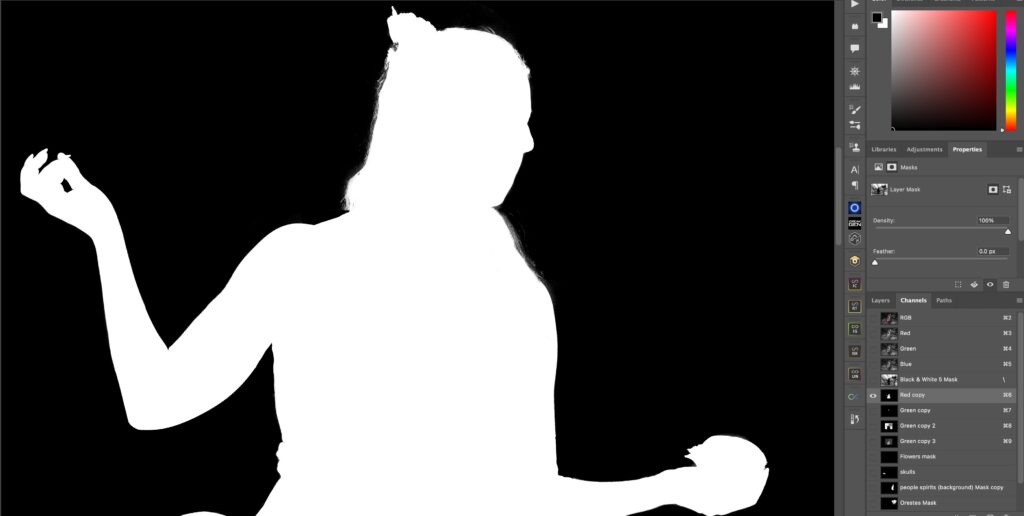
I should have known from my attempts to cut Persephone out of the background in Photoshop that things would continue to be challenging. The fabric we had draped on the back of the chair was not going to work for that stone throne idea, and besides, the fabric was covered in glittery bits. So when I made my alpha channel mask for Persephone, the reflective pieces created a great many white spots that interfered with Persephone’s outline. I had to be a lot more careful in making my mask than usual, and it took time to separate those glittery bits from Persephone’s mask. Note to self: use a solid color fabric if you want to do this.
Once I got Persephone cut out (in summer 2024), I attempted to place her on a throne in a classical painting that had plenty of columns. The result looked awful, and the scale was completely whacked. I tried again and again to execute this simple concept, but I couldn’t find resources that matched my vision.
As time went by and the project fell farther and farther behind, I tried generating backgrounds that initially seemed closer to my vision except that they looked abstract and unreal and the details didn’t make sense.
So I gradually started building the background piece by piece, layer by layer, creating the throne room from my vision from among dozens upon dozens of different elements. In November 2024, I abandoned a version of Persephone that bordered on my vision but was still very far from it. In that version, our Cerberus stood about throne height—big for a dog, but not all that intimidating. It was fine at best.
Distractions
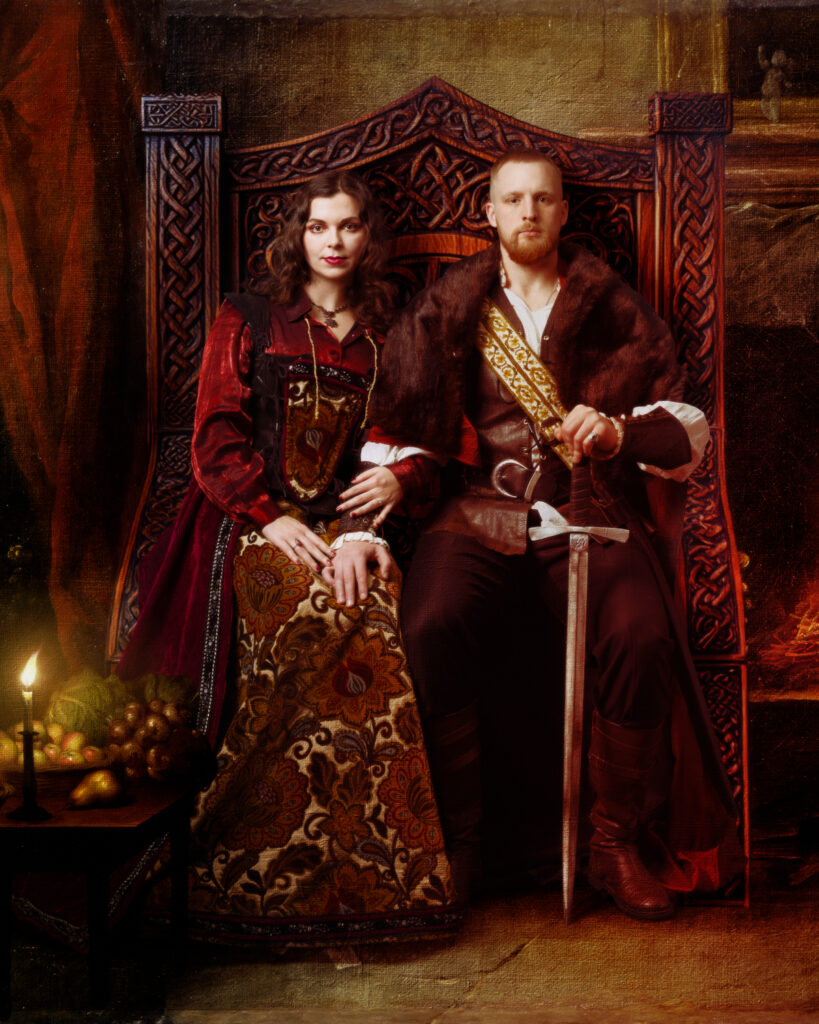
Around this time, client work began to pick up. At the end of the year, I photographed engagement couple Natania and Nick and built two final artworks for them in two weeks, using the same compositing techniques as Gods and Heroes of the Aegean but with simpler goals.
In early 2025, besides Pandora, I felt like I hadn’t put out any of my own personal work since mid-2022, with The People of Light and Shadow. While Gods and Heroes of the Aegean was my passion project, I needed to try a simpler project I could do faster.
I’d had the idea to do an Old Hollywood style project for a while, so Golden Age of the Silver Screen was born. Though originally intended to be a one-off, it proved popular enough to become an ongoing series. The only downside to Golden Age of the Silver Screen is that it took time I could have spent on Gods and Heroes of the Aegean in February and March 2025. In the end, the pros far outweighed the cons. Golden Age of the Silver Screen pushed me into an exploration of hard light and developed an appreciation for the photographers of that era. Furthermore, it was a series without compositing, in which I could produce hundreds of images in a fraction of the time it would take me to make a single image for Gods and Heroes of the Aegean.
In April 2025, I got busy with client work that continued until mid-October, when I finally caught up.
The Devil Is Not in Hades but the Details
Thus, when I had the time to return to Persephone in October 2025, I spent my work days striving to make an image I’d love and be proud of in the way I was of Pandora.
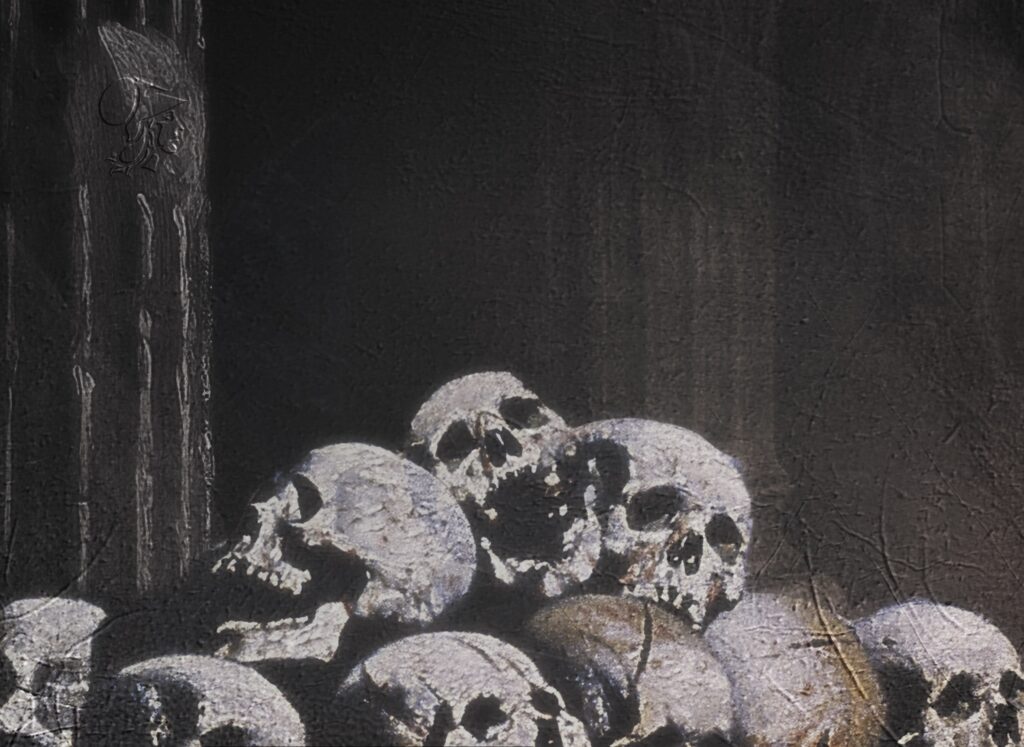
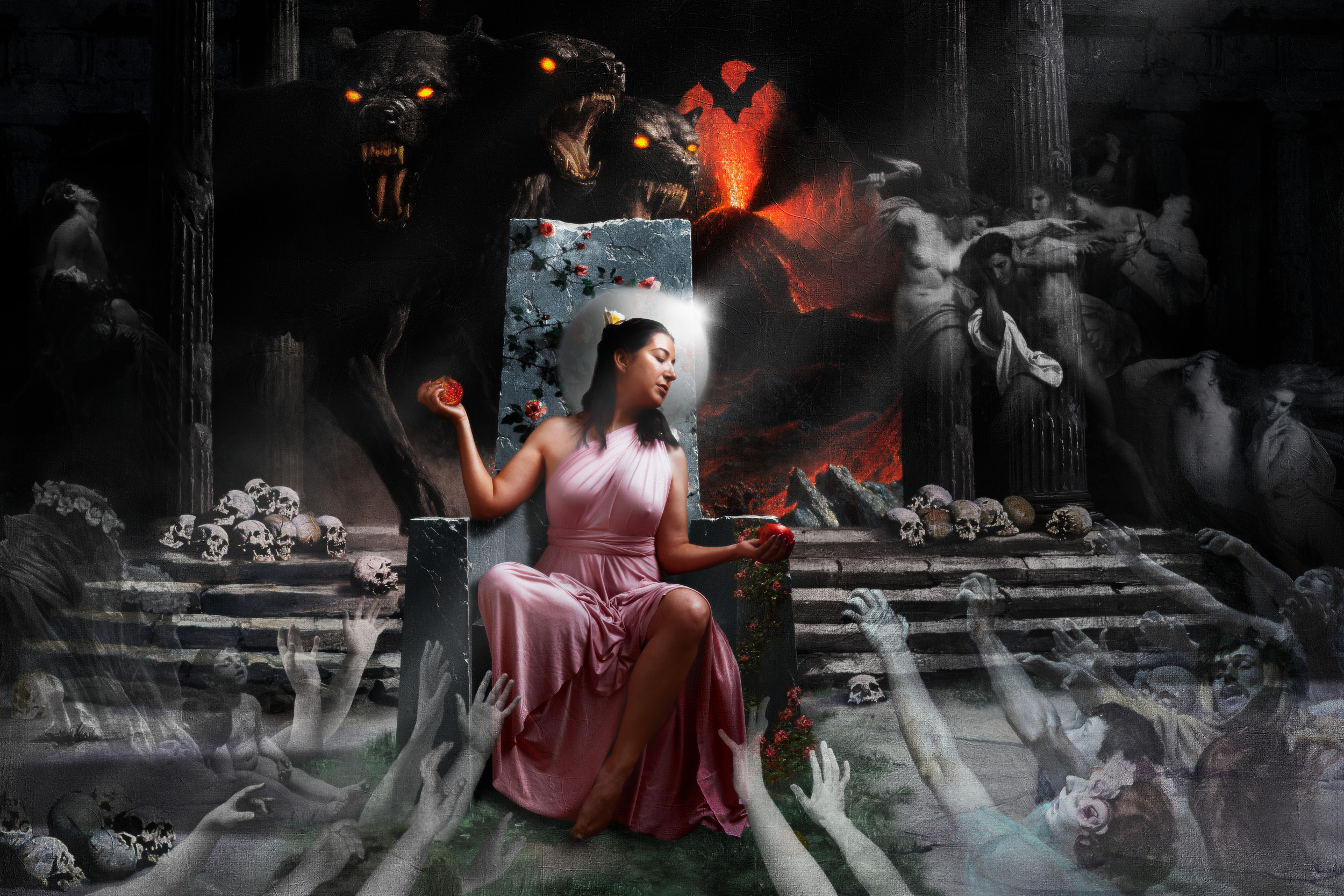
I began by replacing the generated background elements with individual pieces from classical works of art. For example, the stairs, the columns, the back wall, the window, the volcano, the floor, the roses growing on the right side of the throne, and the growth on the floor near Persephone come from different pieces. So do the skulls.
As usual, I got a bit reference heavy and began including every Underworld character I could find. On the right side of the piece, you’ll see the Furies tormenting a soul (the painting depicts Orestes). To the right of them, you’ll see Francesca Da Rimini And Paolo Malatesta from Inferno. Various other Underworld characters entered and left the frame, including Hermes/Mercury, Hecate, and Sisyphus, but discretion prevailed against them.
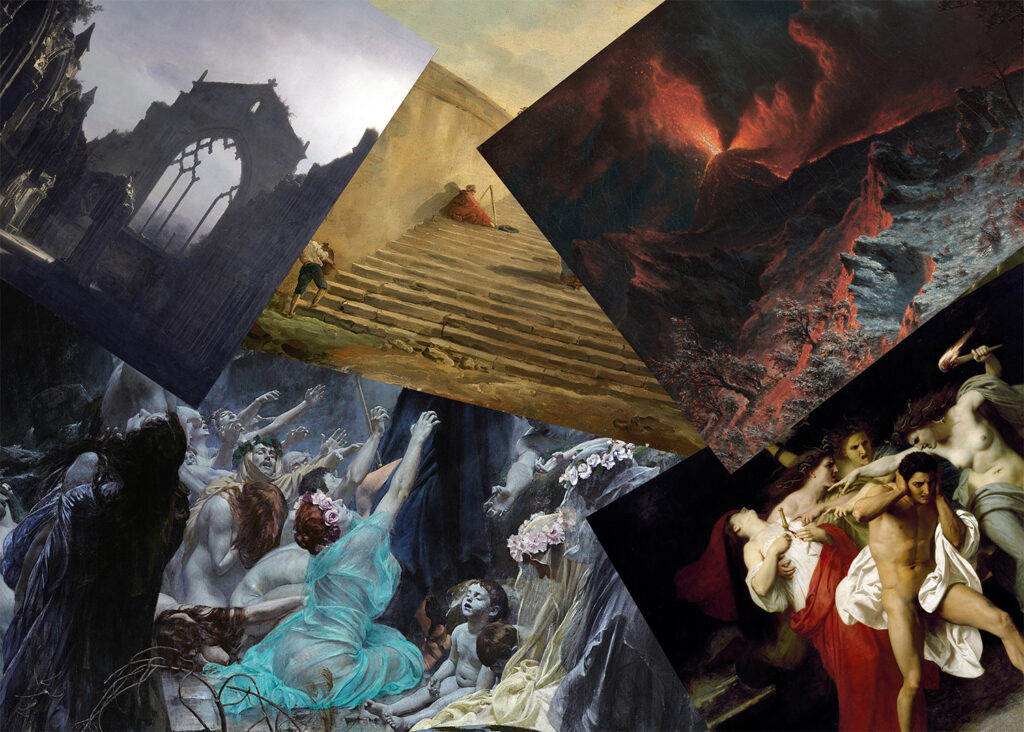
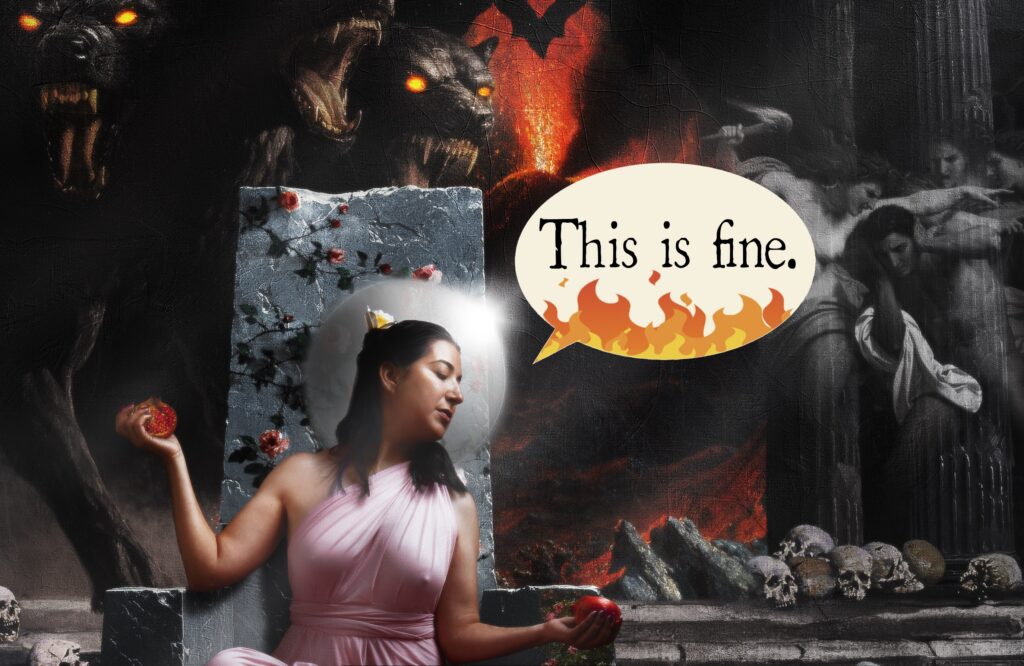
The reaching spirits are one of my favorite elements of the composition and inform the story I wanted to show of Persephone making a choice to stay in Hades and rule over the dead with grace. At one point, I became obsessed with the idea of those arms, and I went through the world of classical art, plundering arms everywhere I could. Saints, sinners, soldiers, saviors—no one was spared! I arranged an Underworld of stone, fire, and the dead, but around Persephone, grass and flowers grow; she wears fresh flowers in her hair, and she holds a ripe fruit in her hand.
The Pomegranate
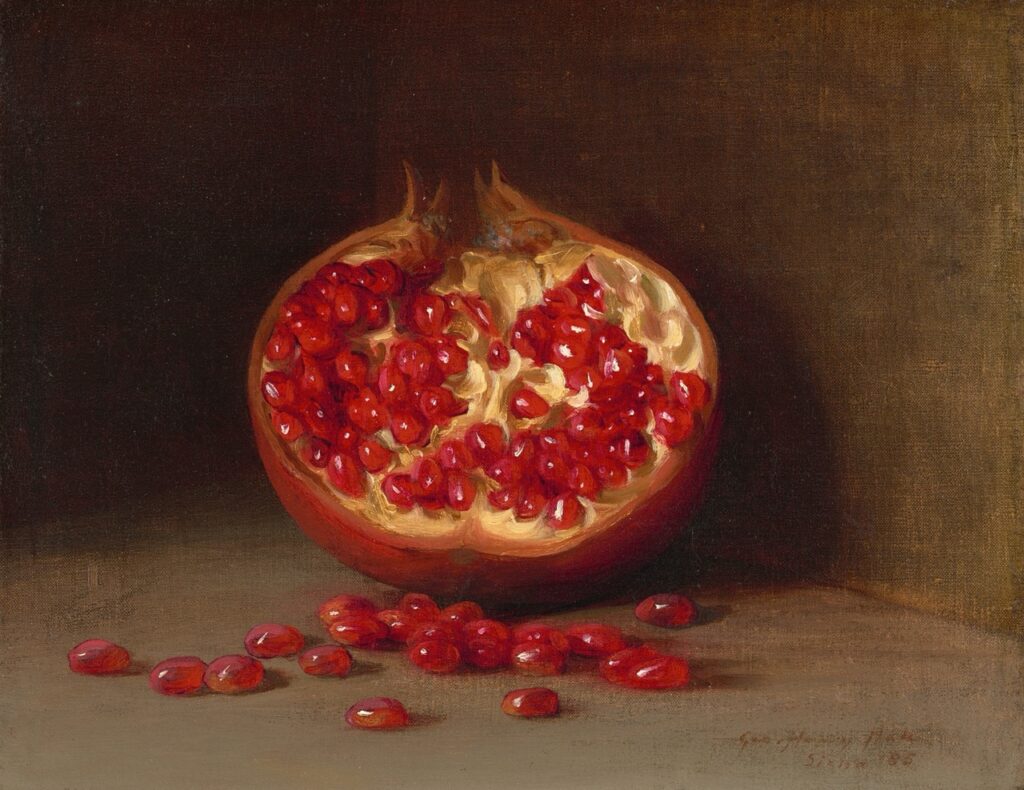
Sarah brought her own pomegranate to the shoot. As I worked on the image, I wondered how clear it would be that she’s holding a pomegranate. As I was plundering the world of classical art, I stumbled on a pomegranate painting by George Henry Hall, which I cut out and placed in Sarah’s empty hand, as though she held both halves of the fruit in either hand. Now, the seeds and shape of the pomegranate were apparent, and the way Persephone held those two halves made me think of a balance, as though she weighed two choices, one hidden and one revealed.
A Game of Thrones and Shadows
To make the throne, I began with a three-dimensional image that I converted to a painterly one, the making of which is a level of detail too deep and dull even for this blog. Seating Persephone on this throne was a more interesting and challenging task, and I went through many variations positioning her and eventually painting in the shadows. Looking at the other shadows in the image and the direction of the light, I estimated where the shadows might fall on the throne and how distinct and dark they would be given their relative proximity to Persephone and the direction and hardness/softness of the light source (as in the picture above).
That was another challenge in the composition: making sure every element had its own shadow that matched the quality and direction of the light and that every new element added to the composition faced the correct direction and angle for the light. And that everything maintained its color relative to the color of the light, which is rather cool and blue in this Underworld image. My plants had been greener and more verdant until Chris Koeppen gave a note that they would not be that warm given the surrounding light source. Once I made that fix, the elements began to work better together in the image. This is to say that every shadow and every color and curves adjustment brought the composition closer to looking good to my eyes.
Hello Haloes
I haven’t been one for using haloes in my images, but I felt there ought to be elements that set the gods apart from mortals. For example, I thought the gods should be indicated by some element of their power. I didn’t want to use the traditional ring haloes commonly associated with Christian angels but with more of a “nimbus.” Uncertain whether I could do what I envisioned, I looked up a tutorial on shading metallic silver, and then I messed around with various layers and gradients until I’d more or less achieved my goal. I liked the way that nimbus sets Persephone apart as a goddess.
Cerberus, the Next Generation
At the beginning of the project three years ago, I had entertained the idea of generating large parts of the compositions. Had I pursued that path, perhaps I’d have finished all fourteen in 2023. In practice, however, I didn’t care for the way this looked. Details were abstract and didn’t look correct, whereas paintings held texture, conscious thought, and eyewitness detail. But then there were monsters.
People are scared, horrified, repelled, and appalled by monsters. Monsters incite panic and fear. Monsters are unnatural. Monsters are twisted and wrong. Monsters are not real. For this project, and for this reason, monsters are generated, and then cut out, warped, reshaped, repainted, textured, and reconstituted by hand, like every other element in this collage.
Sustained Thought and Meditation
So this year and a half on one image: what did it all mean, and was it worth it?
While I plan every Distant Era series with intention, and while I put thought and time into each of the key images in all Distant Era series, I consider the pieces in Gods and Heroes of the Aegean another entity entirely. The subject chooses the character and scene. I visualize what that might look like, and we photograph the subject on black. Then there is this compromise with what resources I can find to make the vision and show the story from the scene that I want to portray. Details are important to me in this series, so I spend a lot of time searching for pieces that will work in these big collages.
Because they have taken so long, I’ve had the time to contemplate what each has meant to me. I’m fortunate to have stellar subjects whose expressions convey the emotion of the scene, even though they stood on a black background under studio lights. It’s my job to give context to those expressions and fill in the world around them. As a result, each piece has accumulated meaning during each stage. These pieces are worth more to me because I have spent so much of my life with them. They are imperfect, but they fairly represent the limits of my skill at present, doing my best.
Gratitude
First and foremost, thanks to photo artist Chris Koeppen, without whom this work would simply have remained a distant dream. His kind counsel and generous advice has been invaluable, and I am grateful to him beyond measure.
Thanks to our Persephone Sarah Moore for being the goddess she is. Her expression, pose, posture, and pomegranate made the rest of the composition what it is, without which it also would not be.
Thanks to Jennifer Mohr for acting as lead costumer and costume consultant on this series and to Erin Gallagher for costume advice. Sarah provided her own costume for Persephone.
Thanks to Quinn Leary for being the myth consultant on Gods and Heroes of the Aegean, as well as for on-set assistance, helping the subjects find themselves, throwing fabric, and the like.
Thanks to Distant Era MVP Elizabeth for her assistance on everything throughout, and for her patience as I have worked on this for a very long time.
Thanks to all the other talented subjects who participated in Gods and Heroes of the Aegean in June 2023, and most of all, thank you for your patience.




This is such a wonderful end product, and I especially appreciate your openness about your process. As a beginner in digital manipulation, I am humbled by the skill you have demonstrated.
Thank you, Ansel! It has been a struggle, and I still feel pretty clumsy starting any new composite, stumbling through fundamentals like the black point of the composition and the color temperature. I often forget about shadows while I’m putting things in place and can be negligent of perspective—and that’s only to name a few. Hopefully with time it will become more natural. My one consolation is looking back seven years and seeing the progress. Thank you again, my good man.